Forming the Future – November Edition

Your Guide to Rollforming & Folding Innovation

2025: Year in Review

We delivered a significant slate of installations across the region – including two Thalmann TD folders, a new variable-purlin line in New Zealand, four nuSLIT cut-to-length lines, two nuIT automation setups and four Tandarra lines into Australia. We also completed a number of major guarding upgrades and unveiled our new Preventative Maintenance software, Total Reliability – just to name a few.


2026 Delivery Estimates


Lead times remain one of the biggest factors shaping 2026 planning. To help you make clearer decisions, we’ve mapped out expected delivery windows across our core suppliers for the year ahead.

Book a call to get a quote

Looking Ahead to 2026


As we move into 2026, our focus is clear: improve reliability, strengthen collaboration and continue delivering value across every part of the ownership experience.

1. Sharper operations and a stronger customer experience

This year, we tightened the internal processes that sit behind our service: better quoting consistency, smoother information flow and improved follow-up systems. Our WhatsApp update line has made communication faster and more transparent, and we’ve combined freight across orders where possible and passed those savings on, and changed FX suppliers in order to ensure our foreign exchange rates are highly competitive.

In 2026, we’ll build on this work — exploring how AI can help us predict lifetime running and maintenance costs by machine, making scheduling more consistent, and ensuring upgrades, training and servicing are easier to plan.

2. Deeper technical collaboration with suppliers

Our partnerships remain the backbone of what we deliver. Next year we’ll continue bringing the latest technology into the region, including:

    OnRoll by CIDAN — variable standing seam rollformer launching into AUS/NZ in 2026  

   ‣ Barida
 — expanded purlin capability with automated stacking and wrapping, plus new industrial lines (road-guardrail, structural systems)

   ‣ Connected Workshops
 — deeper automation and data integration across CIDAN Group machinery and existing customer equipment

These collaborations ensure customers get access to the most advanced systems with trustworthy local support.

3. Consistent value and clearer decision-making

Our priority remains giving customers value based pricing from our best in class suppliers and confidence in their long-term planning.

We’ll continue sharpening internal processes, negotiating stronger supplier terms and aligning specifications to deliver the best possible value across our portfolio.

Book a call to discuss your needs
 
Planning your 2026 equipment strategy? We’re here to help you make informed decisions that improve your bottom line.

Book a call with Lance
Email directly: solutions@totalrollforming.com

The future of sheetmetal fabrication is here—are you ready to embrace it?


   Happy Holidays!

   Wishing you and your teams a safe, well-earned break over the holiday period, and a strong start to the new year. We look forward to working with you in 2026.

1 Comment

Forming the Future – October Edition

Your Guide to Rollforming & Folding Innovation

Tandarra Engineering: Where It All Started

Tandarra Engineering isn’t just one of our key partners. It’s where it all started for me.

Founded by my dad, Brian Watson, in 1982 in the garage at our home in Auckland, Tandarra is where I grew up and cut my teeth in the rollforming industry. From humble beginnings, Tandarra has grown into a 22,000sq ft facility that manages full design, manufacturing, and assembly in-house for customers around the globe.

Tandarra has built a reputation for tackling the difficult jobs—unique profiles and “left of centre” applications that other manufacturers turn away. Whether it’s custom commercial decking systems, complex new profiles, or bespoke mobile rollforming solutions, the team approaches each project with the same attention to detail.

After more than 40yrs of operation, Tandarra is still going strong and Dad still has a passion and energy for producing high quality rollforming lines. With a recent investment in 3 x more CNC lathes and milling machines, they are ensuring that they can continue to supplying the growing market for years to come.

If you’re looking for a standard rollforming solution or have a complex challenge that needs a custom approach, Tandarra can help. Below is a video of the first of 6 x custom conceal fix rollformers supplied to a new Australian customer over the past few years.

https://youtu.be/MxvdN7S2gPA?si=UsGY4P7DIsmACmDD

Book a call to get a quote

Custom Guarding: Because Safety Can’t Be an Afterthought 

Over 13,800 serious injury claims in Australian manufacturing last year. Median payout: $15,800. But that’s just the insurance figure. The real cost includes lost production time, investigations, and covering for injured workers.

Here’s what we see time and again: most accidents happen around machines that have been running fine for years. Workflows change, operators find faster ways to clear jams or load material. Small shortcuts that work, until they don’t.

That’s why we design and install custom guarding solutions across AU/NZ, built to AS/NZS 4024 standards. We don’t just tick boxes. We watch how your team actually uses the line, then design guarding that protects without slowing down legitimate work.

Recent NZ Install

We recently completed a custom safety system for a new rollforming line:

37 panels • 42 posts • 4 interlocked gates • 1 custom 3500L sliding gate

Interlocked gates, emergency stops, and barriers positioned where they’re needed, not just where the manual says.

Time for a safety review? The biggest risks are often the ones you’ve gotten used to seeing.


Book a safety review

Total Reliability: Your Operators Report. We Respond.

We’ve just launched a new service platform that puts reporting power directly in your operators’ hands—the people who know your machines best.

How it works:

  • Scan the QR code on your machine
  • Complete a quick form with issue details and priority
  • Your team and our technicians get notified instantly
  • We address it during the next scheduled service visit

No more lost paperwork. No more forgotten issues. No more “I meant to tell you about that weird noise last week.”

Your operators are closest to the action. Now they can be part of the solution.

Rolling out to our maintenance customers now.


Book a Demo

 
Planning your 2026 equipment strategy? We’re here to help you make informed decisions that improve your bottom line.

Book a call with Lance
Email directly: solutions@totalrollforming.com

The future of sheetmetal fabrication is here—are you ready to embrace it?


                       Smart Investment: Pre-Owned Folding Machines Available Now 

Looking to expand capacity without the lead time and cost of new equipment? We’ve sourced quality second-hand folders that are currently still in operation, but now surplus to requirements and ready for a new owner. 

What’s Available:
✓ Hayes (2008) – Single Folder, 8.2m – Proven workhorse
✓ Thalmann TZ (2020) – Single Folder, 6.4m – Premium Swiss engineering, pictured
✓ Jorns (2020) – Single Folder, 8.2m – Excellent condition

Why buy through us?
1. Technical inspection by qualified service technicians
2. Full transparency on machine condition and history
3. Ongoing parts (Thalmann) and service support available 
4. Fast delivery compared to new equipment lead times

Ready to inspect or discuss? Contact Lance directly: solutions@totalrollforming.com | +61 488 260 004

26 Comments

Forming the Future – September Edition

Your Guide to Rollforming & Folding Innovation

ONROLL: The Mobile Rollformer That Actually Works

CIDAN Machinery just solved the portable rollforming problem.

We’ve seen plenty of “revolutionary” portable rollformers over the years.
Most disappoint when rubber meets road. ONROLL is different. Built with
direct input from contractors who’ve battled with inferior portable units
for years, this machine delivers incredible performance whether you’re on
a factory floor or a remote job site.

The Numbers That Matter:

Speed: 28 metres per minute on 0.55mm BMT
Capacity: Dual 1,360kg decoilers
Material range: 0.42mm to 0.95mm mild steel
Warranty: 5 years on stainless steel tooling

Profiles Made Easy


The centre-drive system eliminates the panel twist that plagues traditional portables.
No guide rails needed. No constant adjustments. The 10.1” touchscreen works with gloves
on and won’t fail in rain (IP66 rated).

Power Flexibility That Makes Sense:

Petrol: 14HP Briggs & Stratton for off-site
Single phase: For workshop use
Three phase: For production runs

Switch power units in under 5 minutes. One machine, every situation covered.


Book a call with Lance

Customer Milestone: Why They Keep Buying CIDAN


Our team in NZ just commissioned the fourth CIDAN unit for one of our long-term customers—with
two more to be installed in the coming weeks.

This unit offers automatic straightening, 5 x knife slitting, a part cut shear with incorporated
label printer that can then be scanned by the downstream folder. Orders are sent to the machine
via our nuIT software solution, that allows your customers to draw and order their flashings
and consumables online via a secure portal embedded within your website.

This end to end solution heavily reduces both paperwork and manual entry of information,
reducing the likelihood of human error during keying operations.

Looking to add a new level of technology to your flashing operation?


Book a call with Lance today

Freight Update: Finally, Some Good News

Shipping costs are finally dropping, substantially.

Recent shipments have shown savings in the thousands of dollars compared to peak rates earlier
this year. While we’re cautious about declaring victory just yet, the trend is encouraging and
should provide some breathing room for customers planning equipment investments.

Every dollar saved on freight is a dollar that can be invested in the machinery itself,
delivering better value for your capital expenditure.

We’ll keep monitoring these costs closely and passing on any savings.


Get a Landed Cost Quote Today

Shutdown Servicing: Book Now

As we move through spring and approach the summer shutdown period (just 10 weeks to go),
now’s the perfect time to start planning essential maintenance work that keeps your equipment
running at peak performance.

Bookings with our New Zealand team are already filling fast. The shutdown period is the perfect
window for preventive maintenance without disrupting production.

Services available during shutdown:

Blade sharpening and replacement
VSD (Variable Speed Drive) servicing and maintenance
Full system audit

Don’t leave maintenance to chance—use the downtime strategically to ensure your equipment is
ready to hit the ground running in the new year.

To book your shutdown maintenance, send us an email via the link below.


Book your Servicing Now

Machine Spotlight: 15 Years and Still Running Strong

Sometimes the best testimonials come from the field.

Lance was recently called out to a 15-year-old Thalmann folder that had a small electrical issue
in the cabinet, that turned out to be simply a loose connection.

During post-repair testing, the operator happened to run a 15 by 15 step profile – and the results
speak for themselves. Clean, uniform, and accurate forming that demonstrates what great service
a Thalmann built machine can offer you, providing you look after it.

It’s a reminder that well-maintained equipment doesn’t just last – it continues to deliver the
precision and consistency your business depends on. Regular electrical checks, preventive
maintenance, and prompt attention to small issues can keep machines performing like new for
decades.

Whether your equipment is 15 months or 15 years old, consistent care pays dividends in
reliability, accuracy, and longevity. Small maintenance investments today prevent major
disruptions tomorrow.

Got questions about ONROLL? Planning your 2026 equipment strategy? Need shutdown servicing?

We’re here to help you make informed decisions that improve your bottom line.

Book a call with Lance 
Email directly: solutions@totalrollforming.com

The future of sheetmetal fabrication is here—are you ready to embrace it?

6 Comments

Forming the Future – August Edition

Your Guide to Rollforming & Folding Innovation

What we’re seeing on the ground: Service wins

There’s lots of media talk on both sides of the Tasman about a slowdown in the manufacturing sector, and in broad terms that no doubt has some truth to it. Tariff talk isn’t slowing and the repercussions are certainly making many nervous, particularly regarding capital equipment upgrades. Interest rates have started to ease, but maybe not as quickly as some expected. Global trade uncertainty and the rollercoaster ride of the NZD and AUD against key currencies are all having impacts and taking their toll.

Broadly speaking, however, the numerous people I’ve recently spoken to fall into two camps:
A number of (predominantly bigger) operators had certainly noticed a pullback and more competition for smaller trade volumes. However, on the flip side, numerous other operators—those I personally see as having a high focus on quality and customer service, or a differentiated product offering—are in fact very busy. A few indicated they were experiencing record months, and the early signs were that August was going to be no different.

I met with one manufacturer recently who won several big contracts from an industry incumbent. How? They listened to their customer’s frustration about equipment damage from daily operations and made a simple design modification to their product. Not only did it eliminate those damage costs, but it actually increased the customer’s capacity. Once implemented, the customer couldn’t imagine going back. That’s the kind of thinking that’s winning right now.

With more options available, your customers are choosing suppliers who offer high-quality, accurate, or clearly differentiated products in a timely and agreed fashion—sometimes even if it costs more. In short, service is key and that’s what appears to be making all the difference.

Within that landscape, we’re also seeing an increased focus on maintenance planning and activity. Those dull blades leaving “a bit of a burr” are now a priority fix because nobody wants to give their customers an excuse to go elsewhere.

Critical spares mapping is also becoming a focus for businesses that want to minimise unplanned production downtime from not having parts available.

As a service-first business, this is obviously a trend we can get behind and it has led us to add our 5th service technician to the TRF family. Welcome Zach!

Whether you’re looking to differentiate your offering or minimise downtime, I’d love to discuss how we can help. Book a call with me here

Purlin Watch: The wait is over!

The first of our variable purlin mills has finally arrived from our production partner Barida Makina in Turkey! All nine 40ft containers were unloaded in record time and the line is starting to come together, led by technicians from Barida who have travelled to New Zealand for installation, commissioning, and operator and maintenance training.Despite a few frustrating shipping delays when the vessel was rerouted to another port at the last minute, we’re now full steam ahead. Once installed, the line—which includes assisted coil loading, 8 dynamic punches, automatic size change, and a 15m automatic stacking and bundling unit—will more than 5 x the production throughput for our customer, with significantly reduced manual handling.More to come next month.

MFB from CIDAN – small, mobile, versatile

This month’s product spotlight is on the MFB 1250mm portable folder from CIDAN Machinery, which attracted a lot of attention at AMW as people got a chance to see just how versatile and easy to operate it is.

With a bending capacity of 1.5mm mild steel (2.25mm aluminium), segmented top and bottom tooling, and available radius tools of R1.0, R2.0 and R3.0, it’s a powerhouse machine that would be a useful asset to any sheetmetal or flashing production shop.

Watch the video below to see it in action. 

Maintenance Tip – Don’t let chain wear cost you downtime

The majority of rollformers are driven by sprocket and chain, an effective method of driving a number of interrelated tooling stages in a controlled fashion.

The extensive loads created by rolling flat coil into different rollformed products gradually stretch these very chains that we rely on to keep the line running.

What happens with chain stretch:

  • Creates weakness in the drive system
  • Can lead to chains breaking
  • Worse still—chain stretch can cause shaft breakage
  • Results in unnecessary and expensive downtime

Make sure you check for chain wear regularly to keep your line running smoothly.


Want to dig deeper into anything from this edition?

Reach out at solutions@totalrollforming.com or give us a call.

The future of sheetmetal fabrication is here—are you ready to embrace it?

4 Comments

Forming the Future – May Edition

Your Guide to Rollforming & Folding Innovation

Latest Install: A new 700mm cover Deck Lands in Sydney

Installed straight after AMW, this high-speed Tandarra built concealed fix line is a welcome addition to our client’s Sydney operation. It is the third identical line we have delivered to their business in Australia.

It’s a smart fit for the growing demand in commercial roofing projects, particularly given the expected lift in commercial construction over the coming years as Sydney’s second airport continues its progress toward completion.  

This install marks another step in our client’s strategy to standardise their product offer and scale production capacity across NSW.

Sneak Peek: Mini Corrugate, Built for Australia

Here’s a first look at one of our latest builds—a Mini Corrugate Rollforming line, developed with Tandarra Engineering and custom-built for an Australian customer.

Traditionally a difficult profile to rollform, Tandarra’s experience and proven technique in building this type of rollformer has shone through again – the piece you see above was the first piece out of the machine! This compact line delivers on space, speed, and simplicity—without compromising on profile quality.

More details to come as it gets crated and shipped.

See Stacey get hands-on with the FX32
She stepped off the laptop and onto the tools… and nailed her first bend on the CIDAN FX32. Turns out, it’s so intuitive, she could run a clean bend first go. 

Ready to Ship: Forstner nuSLIT

If reducing lead times is on your radar, now’s the time. We’ve got one Forstner nuSLIT available for immediate delivery—perfect for fabricators needing fast, accurate material prep without the usual delays.

Right now, delivery freight is under $5K for Australian customers (typically closer to $15K), and we can have it delivered by 30 June—ideal for end-of-financial-year planning. It’s a sharp opportunity to lift capacity and lock in a smart tax-time investment.

We’re counting down to the July install of a custom Barida purlin line, currently en route from Turkey to New Zealand. It’s the second Barida line for this customer—part of a broader investment strategy to scale their production and accelerate growth within the NZ market.

This system is designed to boost forming speed, reduce manual handling, and future-proof operations as demand increases.

Shipment Tracker: Purlin Line Currently in Abu Dhabi, bound for New Zealand

Want to dig deeper into anything from this edition?
Whether it’s machine capabilities, tax incentives, or upcoming installs, we’re here to talk details.

Reach out at solutions@totalrollforming.com or give us a call.

The future of sheetmetal fabrication is here—are you ready to embrace it?

1 Comment

Forming the Future – April Edition

Your Guide to Rollforming & Folding Innovation

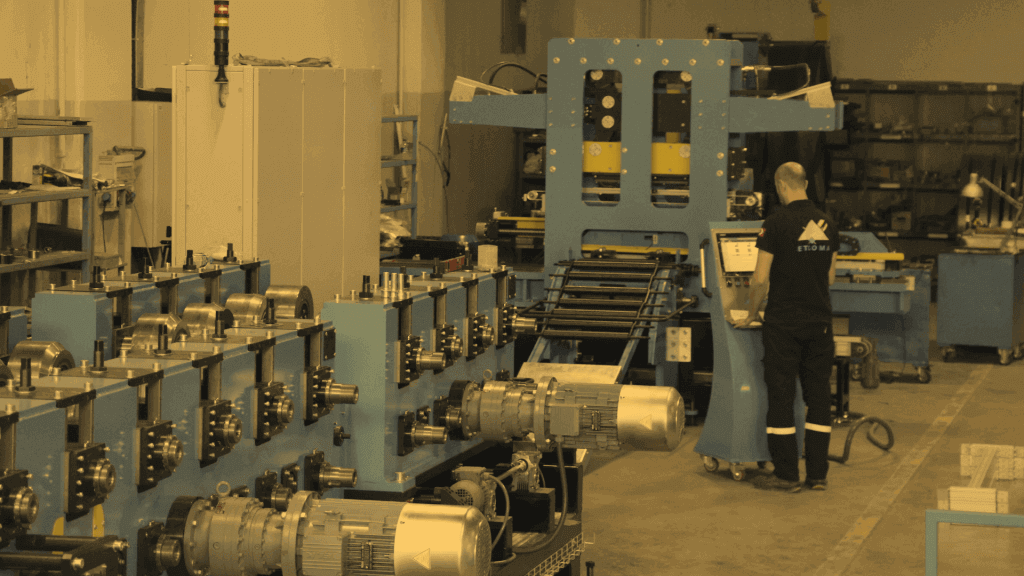
A Complete Etcoma Line, Built for NZ

In late 2024, I travelled to Turkey with one of our NZ clients and our operations manager, Travis Dunn, for the Factory Acceptance Testing of a new Etcoma Purlin rollforming line. It wasn’t just a sign-off trip—it was the latest chapter in a long-standing partnership built on trust, technical insight, and shared goals.

That same line is now en route to New Zealand, with installation scheduled in the coming weeks. It’s been designed to significantly increase our client’s forming capacity, reduce manual handling, and support their plans for growth over the next decade.

From FAT to freight, we’ve managed the process end-to-end—ensuring everything’s ready for a smooth commissioning and a fast ramp-up.

The Etcoma system itself is built for accuracy, speed, and scalability:

Line Highlights:

• Galvanised steel capacity: 1.2mm – 3.0mm
• Complete system: decoiler, straightener, servo feeder, press, 26-station rollformer, exit guillotine, automated stacking of 15m lengths & bundling
• PLC control with Siemens/Schneider technology and remote support
• Built with premium components: CK50 hardened rolls, 21NiCrMo5 gears, Timken, SKF, and FAG bearings
• Safety: Tunnel Guards, light curtains and comprehensive emergency stops

Considering C/Z/Sigma production? Let’s discuss your options.

Why Manufacturers Are Choosing Etcoma

Across Australia and New Zealand, more manufacturers are actively looking for alternatives to the usual machinery suppliers—and Etcoma is fast becoming a serious contender.

For many, it’s not just about finding a better price. It’s about sourcing equipment that delivers stronger long-term value, with less downtime, easier maintenance, and local support that actually turns up.

Here’s why Etcoma is standing out:

✔ Cost Efficiency
Total cost of ownership is typically up to 35% lower than comparable European or U.S. systems (based on ANZ benchmarks from 2021–2024). Spare parts are more affordable, and maintenance is straightforward, thanks to our local support team—keeping lifetime costs down without cutting corners.

✔ Fast Delivery
Custom-built lines are typically delivered in under 10 months. That’s compared to 18+ months from many EU or U.S. brands. Once Factory Acceptance Testing is complete, shipping and installation move quickly—so you’re up and running sooner.

✔ Reliable Build Quality
Etcoma machines are CE-certified, ISO 9001-compliant, and built with trusted global brands like Siemens, SKF, FESTO, and Pilz. We’ve been on the shop floor, and we back what we’ve seen: consistent, high-quality engineering.

✔ Local Support That Actually Shows Up
Every Etcoma machine we supply is supported by our technical team across Australia and New Zealand. That includes a comprehensive 2-year warranty (1 year on wear parts), plus access to local service technicians who know the gear inside out.

If you’ve been weighing up your next machinery investment, Etcoma deserves a serious look—and we’re here to talk you through what that could look like in your business.

Market Volatility: Why Turkish Machinery Holds an Edge

Between freight blowouts and shifting U.S. trade policy, a lot of manufacturers are reassessing where they source machinery. Turkish suppliers—like Etcoma—are proving to be a far more stable option in the current climate.

Here’s what we’re seeing:

Reliable Supply Chain
Turkish supply chains are currently less prone to disruption than those from U.S. manufacturers, particularly as China and other markets counter U.S. tariffs with tariffs of their own, and limitations on component supply.

Lower Exposure to Policy Risk
Unlike current U.S. imports, Turkish machinery isn’t exposed to the same level of uncertainty around ever-changing trading terms—removing another layer of risk from your investment.

In uncertain times, stable supply and pricing matter more than ever. If you’re weighing your next major equipment decision, it’s worth factoring in not just the machine—but how reliably it gets to you.

Automate Your End-of-Line Packing & Wrapping

End-of-line automation is becoming a smart priority for manufacturers looking to scale efficiently. In fact, the new Etcoma Purlin line heading to NZ includes a fully integrated automated wrapping and bundling system—designed to streamline output and reduce manual intervention.

These systems are becoming increasingly sought after across AU/NZ for good reason.

Streamline profile handling and bundling

Deliver consistent, secure strapping and wrap finishes

Reduce reliance on labour for repetitive tasks

If you’re thinking about upgrading, we can show you how this system works in practice—and what a similar setup could look like for your operation.

For more details on Etcoma rollforming lines and how they can transform your production capabilities, visit our website or reach out directly at solutions@totalrollforming.com.

The future of sheetmetal fabrication is here—are you ready to embrace it?


4 Comments

Forming the Future – March Edition

Your Guide to Rollforming & Folding Innovation

Automation in Action:
The Thalmann TD 150 Revolutionising Sheet Metal Fabrication

In the fast-paced world of sheet metal fabrication, speed, precision, and efficiency are paramount. The Thalmann TD Series Double Folders exemplify these qualities, delivering a fully automated process that transforms production capabilities.

A recent demonstration at the CIDAN showroom in Feldkirch, Austria, showcased the TD150 6.4m in action. The results were in our opinion, very impressive:

Part Loading: 13 seconds
Hemming: 12 seconds
Flipping: 14 seconds
Three-Bend Sequence: 10 seconds

These figures aren’t just statistics—they represent a fundamental shift in the ability for manufacturers to improve processing times, with reduced operator intervention. This means a lower cost per part, and a safer, more reliable production environment. 

The Challenge: Manual Handling vs. Automation


Long folding operations have always been a balancing act of labour costs, efficiency, and accuracy. With rising demand and ongoing workforce shortages, reducing reliance on manual labour is no longer just an advantage—it’s a necessity.

Automation can cut labour costs by up to 50%, with machines that previously required two or more operators now efficiently managed by a single person. This shift allows manufacturers to both reduce cost and increase throughput making them more competitive and profitable, particularly in high-cost regions like Australia and New Zealand.

With its automated loading, flipping, and bending, the TD series eliminates inefficiencies, ensuring a streamlined and repeatable process that maintains the highest levels of accuracy. The result? More parts, in less time, with greater consistency—while reducing reliance on semi-skilled manual labour.

A Strategic Investment for the Future

Beyond its impressive speed, the TD series is a long-term investment in the future of manufacturing. Businesses adopting this technology report significantly lower labour expenses, with some achieving more than 50% cost per part savings due to reduced operator requirements and increased throughput.


Its automation capabilities also lead to:

✔ Fewer errors and reduced rework costs
✔ Higher material efficiency and less waste
✔ Enhanced operator safety
✔ A safer, more cost-effective work environment

Automation: A Competitive Necessity in ANZ

For manufacturers in Australia and New Zealand, where labour costs are rising and skilled sheetmetal workers are increasingly hard to find, automation isn’t just an upgrade—it’s essential tool for driving your business forward.

By investing in an automated system like the Thalmann TD Double Folder, businesses can increase production, improve quality and reduce lead times without increasing their workforce—meeting growing demand while maintaining profitability.

Book a time with us for a live demonstration of the latest machines from our partners at CIDAN Machinery, Thalmann and Etcoma.  

For more details on the Thalmann TD Double Folder and how it can transform your manufacturing process, visit our website or reach out at solutions@totalrollforming.com.

The future of sheetmetal fabrication is here—are you ready to embrace it?

2 Comments

The Power of Integration in Sheetmetal Fabrication

In sheetmetal fabrication, precision and speed are no longer nice-to-haves—they’re the lifeblood of operating a profitable business. Customers have become conditioned to wanting accurate parts, delivered in short time frames. With a growing number of manufacturers in our space, they also have multiple options for choice meaning if you dont get it right, and fast – they simply go elsewhere. As machinery gets more sophisticated, the ability to streamline your production processes, reducing or removing the need for manual order is achieveable from a number of integrated software solutions including our own nuIT solution.
It’s about making sure all your systems—from coil selection, cutting, bending or forming, and in some cases packaging, operate seamlessly together. The ability of machines to integrate smoothly with software that controls production schedules, sends and recieves order data, and manages inventory isn’t a luxury; it’s essential for staying competitive.

Why Integration is Essential on the Shop Floor

Today’s manufacturers face more than the usual challenges of throughput and quality. With increasing demand for customisation, tight deadlines, an increasingly unskilled labour force and unpredictable supply chains, manufacturers must find ways to optimise operations and reduce downtime. Integration is the key—it allows every part of the production line to work as a unified system, leading to fewer bottlenecks, better use of resources, and improved overall efficiency.

Picture a scenario where your rollforming line automatically selects and loads the coil for the next job, adjusting itself based on the order specifications. When machines and software talk to each other, you eliminate time-consuming manual adjustments, creating a safer environment with considerably less errors. This isn’t just about streamlining processes; it’s about building a system that can quickly adapt to changing demands without missing a beat.

The Real Benefits of a Connected Fabrication Shop

  1. On-the-Fly Production Adjustments
    Integrated systems let you make real-time changes to production settings without disrupting workflows. For example, Thalmann double folders can sync with production order systems, automatically updating bending requirements based on order data and also load and unload the material and finished parts. This kind of integration increases throughput and ensures consistent quality of production.
  2. Proactive Maintenance
    Integration with widely available predictive maintenance solutions can help catch problems before they lead to breakdowns. By connecting machine sensors to software, you can monitor equipment health in real time. If your oil temperature spikes or a motor begins to vibrate, automated prompts alert you to the change in condition which may allow you to identify and address a developing problem in a timely manner. This proactive approach significantly reduces unplanned stoppages and extends the lifespan of your equipment components.
  3. Streamlining Workflow Automation
    Integration reduces the need for manual data entry and repetitive adjustments. Instead of having your customer service team collect and load orders, for operators to then manually input them into your equipment – why not take the customer supplied data / drawings and send them straight to the machine reducing the opportunity for data entry errors at mulitple points. If something on the order happens to be incorrect, its more than likely that it will be due to a data issue on the part of your customers, not your team.

How to Build a Flexible Tech Stack

A successful tech stack for sheetmetal fabrication / rollforming should be flexible enough to adapt as your needs evolve. Here’s how to make sure your systems are up to the task:

  1. Choose Equipment with Open APIs
    Open APIs allow different systems to share data easily, making it simpler to connect new software or integrate additional machines. This flexibility ensures that your operation can grow or change without the need for costly system overhauls, or leaving you needlessly tied to one manufacturer because their systems dont integrate with that of other suppliers.
  2. Consider Investment in Modular Machinery
    Machines that can be upgraded or automated with additional components as your need for them changes are worth considering. Evalute whether your single deck rollformer can be puchased as a dual level with the option to add the second profile at a later date, or whether your folder can be delivered with the option to add automatic sheet loaders, flipping units, or unloading systems in the future. This makes it easier to scale production or adapt to new types of jobs as your business grows. Our partners, CIDAN Machinery and Tandarra Engineering both offer these modular configurations for folders and rollformers, providing you flexibility and allowing future you to expand capabilities without significant downtime or disruption.

Examples of Integration Making a Difference

  • Fully Automated Folding Lines
    Thalmann’s folding solutions combine their mechanical excellence with production software to provide automated folding operations with safety and precision. From the collection of the customer orders, loading and flipping of material during the folding process and unloading of finished parts – Thalmann offers the most automated folding solutions in the market.
  • Smart Coil Handling
    The Coil Farm by Cidan Machinery allows a modular, automated coil management and equipment loading system that can be integrated with both folding machines and rollforming lines. This innovation dramatically reduces coil change times, with the added benefit of keeping coils in a controlled, and tracked, environment further reducing inefficient movements around your workshop or warehouse. Not content with loading a single machine, the Cidan system provides the option for sharing your coil stock between two different lines.
  • Autochange Purlin Mills
    Etcomas variable Purlin Mills provide automic settings changeover between your specified C, Z and Fascia Purlin products. With dynamic punching and automatic stacking and strapping solutions for products up to 15m in length the Etcoma Purlin can optimise your production, increasing operator safety and reducing product lead times.

How Total Rollforming Supports Integration

At Total Rollforming, we know that seamless integration is crucial for keeping your shop running at peak performance. We work with our partners to provide machines with open communication protocols and API compatibility, making it easy to connect with your existing software or expand as needed. Whether you’re looking to streamline maintenance, automate workflows, or scale operations, we provide the technology and expertise to help you stay ahead of the curve.

4 Comments

Is rolling that “one off”​ job really worth it?

Is rolling that “one off” job really worth it?

Over the years we at Total Rollforming have fielded multiple phone calls from customers who either needed our help to set their machine before running an out of spec job, or needed urgent help because a “one off” job is not running properly or even causing damage to their machine – sound familiar?

A couple of examples as follows;

  • A customer trying to run stainless material through their Rollformer that resulted in significant drive issues, and upon closer inspection, widespread damage to the surface of the tooling that was never designed to run that material.
  • Customer running an export order of 0.9mm galvanised coil through a 15yr old rollformer that normally ran 0.42/0.48mm material, who needed help setting the machine.

In example one, our technicians spent many hours onsite trialing different options to achieve drive, whilst also performing the balancing act of trying to alter lubrication levels in order to reduce the “pickup” that was starting to occur between the stainless coil and steel machine tooling. The job was eventually nursed through at slow speeds resulting in much longer than planned production times. As a result of severe pitting of the machine tooling from the stainless, the customer ended up having to also replace a number of rolls after the job was finished.

The hidden costs probably not factored into the pricing model were;

  • Significant onsite hours by our technicians trying to resolve the problem
  • Slower throughput of the job, meaning more labour hours required to run and pack it
  • Delays to subsequent jobs meaning late deliveries and upset regular customers
  • Overtime labour (at time and half) to catch up and get back on schedule
  • Numerous machine rolls that needed to be replaced as the pitting damage caused by the stainless material was now transferring to regular material jobs.
  • Estimated costs of at least $15,000 – $20,000

For job two, we were called in late Friday afternoon (of course) for a job that had to be run immediately as it was an export order and the container needed packing over the weekend before being collected for shipping early the next week.

The machine that normally ran 0.42/0.48mm material needed multiple adjustments in order to run the 0.9mm galvanised coil specified for this “one-off” job.

I know what some of you might be thinking – “0.42mm is less than half a millimeter more than normal capacity”, however the other way to look at it is that the 0.90mm material is almost twice the thickness that the machine normally, and capably, handles and that which it was designed for. Try putting twice as much specified load into the back of your truck and see what happens.

We ended up regapping the entire machine, had to loosen the tooling on the final few stages to allow the double thickness material to get through the finishing passes with fine roll clearances built into the tool design, and also significantly increased the hydraulic pressure on the shear in order to cut through the material, which still often required two shear cycles before getting through.

In the process of setting the machine and running trial sheets to ensure a profile close to what was required, we also chewed up a bit of coil to the point where the order couldn’t be completed as they ran out of material.(Remember this was an export order, so it involved another container being shipped with the remainder of the job, as the coil was not in stock and had to be ordered in).

Come Monday we had to set the machine back to run bread and butter orders, and at a later date revert to the 0.90mm galv settings once again to complete the order once more coil arrived. Then the problems started… In the months following this job we were called to repair a number of things that started failing. In all we replaced all the chains (likely stretched by the double thickness material), sharpened the guillotine blades, replaced cylinder seals that started to leak within days of completing the job and also a few bearings that presumably were damaged under the additional load combined with the fact they had probably been in the machine for the 15+ years it had been in operation.

The hidden costs probably not factored into the pricing model were;

  • Significant overtime onsite hours by our technicians trying to achieve the profile in the late afternoon / evening.
  • Slower throughput of the job, meaning more labour hours required to run and pack it
  • Additional cost of shipping the 2nd container
  • After the fact repairs and maintenance due to accelerated wear and tear from running this particular job
  • Estimated costs of at least $10,000 – $12,000

These are just two examples of many many similar instances we have dealt with over the years. When all the unforeseen costs of these types of jobs are factored in, I suspect that the “good margins” expected on these “one off” jobs few other suppliers are prepared to produce are significantly reduced, and in some cases I am sure that the jobs ending being produced at a loss.

From a sales perspective I totally understand the lure of saying “Sure we can” to that job that everyone else has refused. The hope is that it builds great credibility and might be the catalyst for picking up that customers on-going regular work moving forward. The point is to make sure that you are factoring in all the likely by-products of running this job into the costing and production scheduling model so that it isn’t costing you money and existing customers in the process.

I regularly field calls asking “Do you think we can run X material (normally considerably thicker or harder than usual) through our machine??” and my response is always the same;

  1. You might end up needing to make numerous changes to the machine in order to get something close to compliant / saleable product – so allow time and money for setup and setting back to normal.
  2. If (and it’s often a big IF) you can run it, then you need to allow for elevated wear and tear on things like bearings and chain, aswell as blade sharpening and other unscheduled maintenance tasks after the fact so put that cost into the quote.
  3. It will likely take twice as long to run as a normal job so factor that into your schedule and labour allocation.
  4. And lastly – when factoring in all of the above – is it worth it? What are the margins like, and how likely are you to get recurring work as a result – because you might just lose some of your current customers in the process.

If infact it turns out that after including all the potential add-on costs that the job is still worth producing, then before committing I suggest you get a sample of coil and trial it because as we all know with rollforming, just because it should work doesn’t mean it will!

That’s it for my first foray into content writing on this platform. If you are still here, thanks for taking the time to read this – I hope that its provided some useful nuggets you can consider / apply to that next “one-off” job that comes through the sales office.

All feedback welcomed, and if you wish to discuss in more detail, dont hesitate to reach out.

Tagged , | Leave a comment